Semolina Cake Complete Guide, Moist Pakistani Recipe, and 5 Stunning Variations
Complete guide Pakistani sooji fusion Naturally moist Easy 5.0 / 5
Sooji
Ka Cake
45 min
Prep + bake
Naturally
Moist always
Easy
Skill level
The history of Semolina Cake across global and Pakistani food traditions:
Semolina the coarsely ground endosperm of durum wheat has been used in sweet cake and dessert preparations across the Mediterranean, Middle East, and South Asia for thousands of years, producing a family of semolina cakes that spans cultures and continents while sharing the same fundamental insight: semolina’s coarser grain structure, higher protein content, and different water absorption properties produce baked goods with a distinctive, irreplaceable texture and flavor that softer wheat flours simply cannot match. The Egyptian basbousa perhaps the most widely known semolina cake in the Arab world is a dense, syrup-soaked semolina cake made with yogurt and flavored with rose water and coconut, cut into diamond shapes and garnished with whole almonds. The Greek revani and the Turkish irmik keki are closely related semolina cake traditions lighter, often lemon-scented, similarly syrup-soaked. The Lebanese and Syrian sfoof is a turmeric-tinted semolina cake. The Iranian ranginak and Persian sholeh zard share semolina’s place in their grain-based dessert traditions.
In Pakistan, sooji (semolina) has been used in sweet preparations since at least the Mughal period sooji halwa appears in Mughal court records as a preparation of royal prestige, made with ghee, sugar, cardamom, saffron, and garnished with pistachios and almonds in a combination that defines Mughal dessert aesthetics. This sooji halwa tradition essentially a very wet, cooked semolina pudding is the direct culinary ancestor of the Pakistani semolina cake. The same grain, the same aromatics (cardamom, rose water, saffron), the same garnishes (pistachio, almond) simply structured into a baked cake format rather than a stovetop pudding. The semolina cake in this sense is not a foreign preparation adopted by Pakistan but the natural evolution of Pakistan’s own sooji tradition into a contemporary baked format.
The modern Pakistani semolina cake movement has been driven by Pakistani food bloggers, cafe bakers, and home cooks who have discovered that basbousa-style semolina cake adapted with Pakistani aromatics (cardamom, rose water, kewra) and Pakistani garnishes (pistachios, dried rose petals, silver warq) — resonates powerfully with Pakistani taste preferences and Pakistani dessert culture. The syrup-soaked format is familiar from Pakistani mithai tradition; the grain texture of sooji is beloved from halwa; the aromatic profile of cardamom and rose water is quintessentially Pakistani. The result is a cake that feels completely Pakistani despite its global semolina cake heritage a perfect example of the cultural culinary exchange that has always shaped Pakistani food.
The science of Semolina Cake why semolina produces unique results:
Semolina’s grain structure why it bakes differently than wheat flour:
Semolina is made from durum wheat (the hardest, highest-protein wheat variety) that has been ground to a coarser particle size than all-purpose flour the individual semolina particles are larger, more angular, and less uniform than the fine powder of processed white flour. This coarser grain structure has profound effects on baking behavior. Water absorption: semolina absorbs water more slowly than fine flour, requiring the batter to rest before baking so the semolina can fully hydrate impatient baking of unrested semolina batter produces a gritty, underdeveloped texture. Structure: semolina’s higher protein content and coarser particle size produce a denser, more substantial crumb than all-purpose flour cakes. Texture: the partially-whole grain character of semolina produces the characteristic pleasant graininess of semolina cake not gritty, but with a distinct textural interest that all-purpose flour cake completely lacks.
Why semolina cake stays moist the syrup science:
The syrup soak applied to semolina cake immediately after baking is the technique that defines the preparation’s most distinctive and most celebrated quality its extraordinary, sustained moistness that persists for days after baking. The mechanism: hot cake from the oven is porous and actively absorbing the rapid evaporation of water during baking has created a network of tiny channels throughout the crumb that draw in liquid through capillary action when the syrup is applied. Warm cake absorbs syrup far more completely than cooled cake the syrup floods into the crumb’s capillary network and as the cake cools, the network closes partially, trapping the syrup inside. The sugar in the syrup is hygroscopic it attracts and retains ambient moisture, preventing the cake from drying out over subsequent days. A well-soaked semolina cake is genuinely more moist on day two than day one.
The role of yogurt in semolina cake tenderness and tang:
Yogurt (dahi) is the most common liquid ingredient in Pakistani semolina cake and its contribution goes far beyond mere moisture. Yogurt’s lactic acid partially breaks down the semolina’s starch and protein structures during the batter resting period, producing a more tender, less dense crumb than semolina baked without acid. The fat in full-fat yogurt lubricates the gluten structure, further contributing to tenderness. Yogurt’s natural tang provides a subtle background acidity that balances the cake’s sweetness and makes the aromatics (cardamom, rose water) more vivid and more complex the acid activates and amplifies flavor perception in ways that neutral liquid ingredients cannot. Full-fat yogurt is strongly preferred over low-fat versions the fat content is critical to both the tenderness and the richness of the finished cake.
Nutritional Highlights of Semolina Cake:
Protein
Higher than maida
Iron
+ B vitamins
Slow
Energy release
Naturally
Dense + filling
Ingredients:
For Classic Pakistani Semolina Cake (One 9-inch Round)
Fine Semolina (Barik Sooji)
2 cups fine grind only
Full-Fat Yogurt (Dahi)
1 cup room temperature
Ghee or Butter (melted)
½ cup ghee for Pakistani character
Caster Sugar
¾ cup in batter
Eggs
3 large room temperature
Green Cardamom + Baking Powder
1 tsp ground + 1½ tsp
Rose Water or Kewra
1 tbsp Pakistani aromatic
REST TIME
20–30 min minimum non-negotiable
For Pakistani Cardamom Rose Saffron Syrup Soak
Water + Sugar
1 cup + ¾ cup
Rose Water + Lemon Juice
2 tbsp + 1 tsp add OFF heat
Cardamom Pods + Saffron
4–5 whole + generous pinch
Apply IMMEDIATELY
While cake is maximally hot
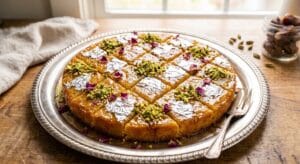
For Pakistani Semolina Cake Garnish (Mughal Style)
Blanched Almonds
Whole one per diamond piece
Crushed Pistachios
Pakistani signature garnish
Dried Rose Petals (Gulab Patti)
Food-grade Pakistani dried roses
Silver Warq
Edible Mughal tradition
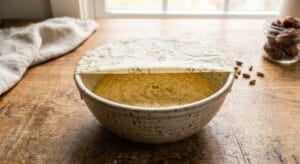
Step-by-step Classic Pakistani Semolina Cake (signature recipe):


5 secrets for perfect Semolina Cake:
Secret 1 Rest the batter minimum 20 minutes non-negotiable:
Secret 2 Soak with hot syrup immediately from the oven timing is everything:
Secret 3 Use fine semolina coarse semolina produces gritty cake:
Secret 4 Add rose water and kewra to syrup off heat preserve aromatics:
Secret 5 Score before baking, not after deeper syrup penetration:
Semolina Cake variations:
Classic Pakistani Cardamom Semolina Cake (signature most beloved):
Lemon Semolina Cake (Greek revani-inspired):
Coconut Semolina Cake (Pakistani-tropical fusion):
Rose and Pistachio Semolina Cake (Mughal luxury version):
Tips and tricks:
- Rest batter minimum 20–30 minutes non-negotiable. Unrested semolina produces gritty texture; rested semolina produces smooth, cohesive, magnificent crumb.
- Soak immediately from the oven while maximally hot warm cake absorbs syrup completely; cooled cake absorbs only partially, producing uneven moistness.
- Use fine sooji (barik sooji) coarse semolina produces unacceptable grittiness. Fine grind gives distinctive texture without roughness.
- Add rose water and kewra to syrup off heat boiling destroys volatile aromatics. Add after removing from heat and cooling 2–3 minutes.
- Score deeply before baking creates syrup channels for even, deep penetration. Score halfway through batter depth, not just surface marks. Date Cookies
- Use full-fat yogurt only low-fat yogurt produces a drier, less tender cake. The fat in dahi is essential for the cake’s final texture richness.
- Use ghee rather than butter for the most Pakistani character ghee’s nutty depth adds a dimension of flavor that dairy butter cannot provide.
Frequently Asked Questions:
Q1. What is Semolina Cake called in Pakistan?
Semolina cake is called sooji ka cake or suji ka cake in Urdu. Also called basbousa (the Arab name adopted in Pakistani food media), or sooji mithai/sooji halwa ka cake connecting it to the beloved sooji halwa tradition. In Pakistani cafe culture, increasingly called “semolina cake” in English or “sooji cake” in the mixed Urdu-English typical of urban Pakistani food culture.
Q2. Is Semolina Cake the same as basbousa?
Closely related both semolina-based, both syrup-soaked. Pakistani semolina cake differs in aromatic profile: uses cardamom, rose water, kewra, and saffron rather than basbousa’s typical vanilla and coconut. Pakistani versions use ghee rather than vegetable oil, producing a distinctly richer, more Mughal-flavored result. Techniques are essentially identical the difference is entirely in aromatics and garnishes that make Pakistani semolina cake unmistakably South Asian in character.
Q3. Can I make Semolina Cake without eggs?
Yes eggs primarily provide binding and moisture. Substitutes per egg: 3 tbsp yogurt (strengthens lactic acid tenderization); flax egg (1 tbsp ground flaxseed + 3 tbsp water rested 5 min); 3 tbsp condensed milk (adds binding and sweetness). Egg-free semolina cake is slightly denser the generous syrup soak compensates beautifully. The syrup’s moisture is particularly valuable in egg-free versions.
Q4. Why is my Semolina Cake gritty?
Two primary causes: insufficient batter resting (most common semolina not fully hydrated) or using coarse-grind semolina instead of fine. Solutions: always rest batter minimum 20–30 minutes (ideally 1 hour); always use fine-grind barik sooji; ensure yogurt and eggs are room temperature (cold liquid slows semolina hydration significantly). If grittiness persists: briefly blend dry semolina in food processor before using to reduce particle size further.
Q5. How much syrup should I use for Semolina Cake?
A generous application the finished cake should be clearly, visibly moist and glistening, not merely touched with liquid. Standard ratio for 9-inch cake: 1 cup water + ¾ cup sugar (approximately 1¼ cups finished syrup) use all of it. The cake cannot be “over-soaked” if properly baked — a well-baked semolina cake absorbs enormous quantities without becoming soggy because its grain structure holds liquid within its network rather than collapsing.
Q6. How long does Semolina Cake last?
Remarkably well significantly longer than conventional cakes. Room temperature covered: 3 days excellent quality, often improving day two as syrup distributes fully. Refrigerated sealed: up to 1 week. Syrup’s high sugar content is hygroscopic (retains moisture) and acts as natural preservative. Quality genuinely improves with 1–2 days resting bake the day before serving for the best possible result.
Q7. Can I make Semolina Cake without yogurt?
Yes substitutes: full-fat sour cream (same acidity and fat virtually identical results); coconut milk yogurt for dairy-free (subtle coconut note); labneh thinned with small amount of water (richer, more concentrated); full-fat milk + 1 tbsp lemon juice (replicates lactic acid function reasonably well). Always avoid low-fat alternatives fat content is essential for tenderness and richness. Yogurt strongly preferred; substitutes produce acceptable but not identical results.
Q8. What do I serve with Semolina Cake?
Best pairings: karak Pakistani chai (warm spices in cake and chai create natural harmony one of the finest cake-beverage pairings in Pakistani culture); vanilla ice cream (cold neutral creaminess against warm spiced syrup-soaked cake is extraordinary); clotted cream or kaymak (thick Pakistani malai adds dairy richness); fresh fruit particularly mango or pomegranate seeds (tartness cuts through sweetness beautifully); or simply alone at room temperature where the cake’s own qualities need no accompaniment.
You May Also Like:
Rose Cake Complete Guide, Elegant Pakistani Recipe, and 5 Stunning Variations

