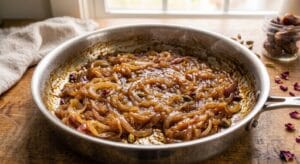
Onion Jam Complete Guide, Caramelized Pakistani Recipe, and 5 Stunning Variations

Onion Jam Complete Guide, Caramelized Pakistani Recipe, and 5 Stunning Variations

Complete guide        Pakistani pyaz fusion         3 weeks shelf life                                                       Easy        5.0 / 5

Onion Jam is one of the most surprisingly magnificent, most deeply complex, and most genuinely transformative condiment preparations in all of slow cooking a thick, glossy, intensely sweet-savory, deeply caramelized jam made from slowly cooked onions that concentrates hours of patient heat into a spoonful of extraordinary umami richness, natural sweetness, aromatic depth, and remarkable versatility that makes it one of the most indispensable condiments a Pakistani kitchen can produce. Onion jam pyaz ki jam in Pakistani Urdu transforms the humble onion, Pakistan’s most essential and most abundantly used vegetable, into a preparation of remarkable luxury through the simple alchemy of time, low heat, and patience taking a raw, pungent, sharp vegetable and revealing the extraordinary natural sweetness, the deep caramel complexity, and the silky, jammy texture that lies hidden within every pyaz.
In Pakistan, the onion — pyaz — occupies a position of absolute culinary centrality that is almost impossible to overstate. There is virtually no savory Pakistani dish that does not begin with pyaz — every curry, every karahi, every daal, every biryani, every kabab, every chutney begins its flavor construction with onion in some form. Pakistani cooks are masters of onion in its many states — raw and pungent in salads and raita, golden-fried as birista for biryani, slow-cooked to a dark jammy paste as the base of rich kormas and qormas. The onion jam is the ultimate expression of this Pakistani onion mastery taking the slow-cooking intuition that already exists in Pakistani cooking and applying it with French-inspired precision and patience to produce a condiment of outstanding, stand-alone quality.
In this complete guide you will find everything needed to understand, make, and genuinely master onion jam its history in French and Pakistani cooking traditions, the extraordinary science of caramelization and Maillard reactions that transform raw onion into deep amber jam, the impressive health benefits of slowly cooked onion’s concentrated quercetin and prebiotic compounds, step-by-step signature recipe, five outstanding variations from classic French to Pakistani-spiced to balsamic fusion, and all the professional tips that guarantee consistently deep, glossy, magnificently flavored onion jam every single time.

Pyaz

Ki Jam

45–60

min slow cook

3 weeks

Fridge life

Easy

Skill level


The history of Onion Jam in French and Pakistani culinary traditions:

The concept of cooking onions slowly until they collapse into a sweet, jammy, deeply caramelized condiment has roots in multiple culinary traditions across the world reflecting the universal human discovery that patient low-heat cooking transforms onion’s sharp pungency into something unexpectedly, remarkably sweet and complex. In French cooking, the confiture d’oignons (onion jam or onion confit) is a classic preparation of the Alsace and Gascony regions traditionally served alongside foie gras, duck confit, and rich charcuterie where its sweet-savory balance provides the perfect counterpoint to fatty, rich proteins. The French onion jam tradition uses wine (red or white), sugar or honey, and vinegar alongside the slowly cooked onions producing a refined, balanced condiment of extraordinary depth that has become a staple of French bistro cooking and modern gastropub menus worldwide.
In Pakistani cooking, the concept of slow-cooked, deeply caramelized onion is not foreign at all it is embedded in the most fundamental techniques of Pakistani curry making. The birista (barista) deep-fried caramelized onion is perhaps Pakistan’s most labor-intensive and most flavor-critical condiment, used as a garnish and flavor base in biryani, korma, and nihari. The slow bhuno of onion at the beginning of every karahi and curry cooking pyaz in oil until deeply golden, almost brown, before adding any other ingredient is the foundational step of Pakistani cooking technique. Onion jam takes this existing Pakistani onion-cooking wisdom and refines it into a standalone condiment of shelf-stable, versatile, absolutely outstanding quality that can be made in advance and used throughout the week to instantly elevate dozens of preparations.
The modern Pakistani onion jam movement has been driven by Pakistani food bloggers, cafe chefs, and home cooks who have discovered that adding Pakistani aromatics cumin, red chili, amchur (dried mango powder), fresh green chili to the French-inspired slow-cooked onion jam format produces a condiment that is simultaneously globally sophisticated and deeply, authentically Pakistani. A Pakistani onion jam spread on a burger bun, used as a base for a karahi, stirred into eggs, or served alongside seekh kabab is one of the most original and most genuinely useful Pakistani fusion condiment concepts available elevating everything it accompanies while requiring only time, patience, and the most universally available Pakistani vegetable.

The science of Onion Jam caramelization and Maillard chemistry:

Why onions become sweet when cooked slowly:

Raw onions contain complex fructooligosaccharides chains of fructose molecules that give onions their characteristic pungency and their mildly sweet background flavor. During slow, low-heat cooking, enzymes and heat progressively break these fructooligosaccharide chains into simpler fructose and glucose molecules the same sugars found in fruit. These simple sugars are sweet-tasting and Maillard-reactive (they undergo browning reactions with proteins that produce caramel-like flavor compounds). As cooking progresses over 45–60 minutes, the released simple sugars caramelize, the Maillard reactions build hundreds of complex aromatic compounds, and the onion’s cellular structure collapses transforming from a crisp, pungent raw vegetable into a soft, sweet, deeply complex jammy mass of extraordinary flavor.

The role of acid in Onion Jam balance and preservation:

The addition of acid balsamic vinegar, red wine vinegar, apple cider vinegar, or in Pakistani versions, amchur or tamarind to onion jam serves multiple simultaneous functions. Flavor balance: the acid’s tartness cuts through the concentrated sweetness of caramelized onion, preventing the jam from being cloying and creating the sweet-sour-savory complexity that makes onion jam so addictive. Color preservation: acid stabilizes the caramelized pigments, preventing the jam from oxidizing to an unappetizing gray-brown during storage. Preservation: acid lowers the pH of the finished jam, inhibiting microbial growth and extending refrigerator shelf life from days (acid-free) to 2–3 weeks (properly acidified). The acid is added in the final stage of cooking adding it too early slows the caramelization process by preventing the pH conditions needed for optimal Maillard reactions.

Why onions reduce so dramatically during cooking:

A kilogram of raw onions produces approximately 250–300g of finished onion jam a reduction of 70–75% that explains both why onion jam is so intensely flavored and why it seems to require so many onions for a small amount of finished product. This dramatic reduction occurs because onions contain approximately 89% water by weight and slow cooking drives off most of this water as steam, concentrating the remaining solids (sugars, proteins, fiber, flavor compounds) into a dense, intensely flavored mass. The concentration process multiplies all flavor compounds proportionally a small amount of finished onion jam contains the flavor concentration of many times its weight in raw onion. This is why onion jam has such extraordinary impact in small quantities a tablespoon carries the caramelized flavor of several full onions.

Health Benefits of Onion Jam:

Quercetin

Anti-inflammatory

Prebiotic

Gut health

Sulfur

Compounds

Low

Calorie condiment

Onion jam concentrates the remarkable health-beneficial compounds in onions into a small, flavorful, easily consumed form making it one of the most nutritionally interesting condiments available. Quercetin the most abundant flavonoid in onions and one of the most extensively researched anti-inflammatory compounds in plant foods is concentrated in onion jam to levels significantly higher per gram than in raw onion. Research associates regular quercetin consumption with reduced cardiovascular disease risk, reduced blood pressure, anti-cancer properties, and reduced inflammatory markers. The prebiotic fructooligosaccharides in onion partially modified but not eliminated by cooking feed beneficial gut bacteria and support microbiome diversity. Onion’s organosulfur compounds (the same family of compounds responsible for allicin’s benefits in garlic) provide antimicrobial and potential anti-cancer properties that survive moderate cooking temperatures. Per tablespoon, onion jam is a low-calorie condiment (approximately 30–40 calories depending on added sugar) that delivers significant flavor impact with meaningful nutritional contribution.
Quercetin concentration:  Slow cooking concentrates onion’s quercetin one of the most researched anti-inflammatory flavonoids to significantly higher levels per gram than raw onion, making onion jam a genuinely health-beneficial condiment.
Prebiotic gut health:  Onion’s fructooligosaccharides prebiotic fibers that feed beneficial gut bacteria are present in onion jam, supporting gut microbiome diversity and digestive health.
Cardiovascular benefits:  Regular quercetin consumption is associated with reduced blood pressure and cardiovascular disease risk making regular onion jam consumption a genuinely heart-protective dietary habit.
Big flavor, low calories: Approximately 30–40 calories per tablespoon an extraordinarily flavorful condiment that adds remarkable depth to any dish without significant caloric cost.

Ingredients:

For Classic Pakistani Onion Jam (Signature Recipe)

Large Red Onions

1 kg thinly and uniformly sliced

Olive Oil or Mustard Oil

3 tbsp base cooking fat

Butter or Ghee

1 tbsp richness and depth

Gur (Jaggery) or Brown Sugar

2–3 tbsp caramelization

Balsamic or Apple Cider Vinegar

2 tbsp add LAST after caramelizing

Salt + Black Pepper

1 tsp + ½ tsp freshly ground

Fresh Thyme or Cumin Seeds

4 sprigs or 1 tsp aromatic

Heavy-Bottomed Pan

Cast iron or thick stainless essential

 For Pakistani-Spiced Onion Jam (Desi Fusion)

Red Onions + Mustard Oil

1 kg + 3 tbsp sarson ka tel

Gur + Amchur

3 tbsp + 1 tsp natural sweetness and tang

Tamarind Paste

1 tbsp Pakistani sourness

Cumin + Red Chili + Green Chili

1 tsp + ½ tsp + 2–3 chopped

 For Storage and Pakistani Serving

Sterilized Glass Jar

Essential  never plastic

Burger Buns or Naan

Primary Pakistani serving vehicle

Aged Cheddar or Cream Cheese

Outstanding pairing always

Seekh Kabab or Grilled Chicken

Best Pakistani meat pairing


Step-by-step Classic Pakistani Onion Jam (signature recipe):

Slice onions uniformly the foundation of even caramelization: Peel and halve 1 kg of large onions. Slice each half into thin, uniform half-moon slices approximately 3–4mm thick uniform thickness is critical for even cooking, as thicker slices take longer to soften while thinner ones cook faster, and the resulting uneven texture produces inconsistent jam. The best tool: a sharp chef’s knife or a mandoline slicer set to 3mm. 1 kg of raw onions appears to be an enormous quantity filling a large pan to overflowing but will reduce dramatically during cooking to approximately 250–300g of finished jam. Do not be alarmed by the quantity; the reduction is the point. Red onions produce a deeper colored, more complex-flavored jam; yellow onions produce a sweeter, milder jam. Pakistani red onions from local markets are strongly recommended for their bold, complex flavor.
Onion Jam on Desi Bites
Start with fat and salt draws moisture and begins softening: Heat olive oil (or mustard oil for Pakistani character) and butter or ghee together in a large, heavy-bottomed pan or Dutch oven over medium heat. The combination of oil and butter provides the oil’s high smoke point for initial cooking and the butter’s flavor contribution for final depth. Add all the sliced onions at once they will seem impossibly abundant. Add salt immediately and toss to coat. The salt is not merely a seasoning at this stage it draws water from the onion cells through osmosis, accelerating the initial softening phase and releasing liquid that prevents burning during the first 10–15 minutes of cooking. Stir well and reduce heat to medium-low. The onions will begin to release steam and soften within 5 minutes.
Cook slowly on medium-low the patience phase (30 minutes): Cook the onions on medium-low heat, stirring every 3–5 minutes for the first 30 minutes. This is the patience phase  the onions are sweating, releasing their water content, and progressively softening and collapsing from their original volume. During this phase the onions should be gently sizzling but never aggressively frying the sound should be a gentle, steady sizzle rather than an aggressive pop. The color during this phase progresses from raw white/purple through translucent, then pale golden, then golden. Do not rush this phase by increasing heat higher heat causes the onions to fry rather than sweat, producing uneven caramelization where some pieces burn while others remain barely cooked. After 30 minutes the onions should be reduced by approximately half, soft throughout, and golden.
Onion Jam on Desi Bites
Add sugar/gur and deepen the caramelization (15 minutes): After 30 minutes of patient slow cooking, add brown sugar or gur (jaggery) and fresh thyme sprigs or cumin seeds. The sugar addition at this stage accelerates the caramelization and Maillard reactions that produce onion jam’s characteristic deep amber color and extraordinary flavor depth. Stir to incorporate and continue cooking on medium-low, now stirring more frequently (every 2 minutes) as the increased sugar content raises the burning risk. The onions will darken progressively from golden to deep amber over the next 10–15 minutes this is the caramelization stage where the most complex flavors develop. Watch carefully  the difference between perfectly caramelized deep amber and burnt is approximately 2 minutes. The correct endpoint: deep amber-brown, intensely fragrant, jammy and glossy, with no raw onion texture remaining.
Deglaze with vinegar the flavor completion and balance: When the onions are deeply caramelized and jammy, add balsamic vinegar (or apple cider vinegar, or for the Pakistani version, amchur dissolved in water and tamarind paste). The vinegar will sizzle dramatically as it hits the hot pan this is the deglaze, dissolving any caramelized onion stuck to the pan base (these fond deposits are packed with flavor) and incorporating them back into the jam. Stir vigorously for 30 seconds as the vinegar reduces. Taste immediately the flavor at this moment is extraordinarily complex: sweet from the caramelized sugars, sour from the vinegar, savory from the concentrated glutamic acid, and deeply aromatic from the herbs or spices. Adjust seasoning: more salt if flat, more sugar if too sharp, more vinegar if too sweet. The finished jam should achieve a perfect, addictive sweet-sour-savory balance.
Onion Jam on Desi Bites
Check consistency and final seasoning the perfectionist stage: The finished onion jam should have a thick, glossy, spreadable consistency similar to a chunky fruit jam in texture, coating the back of a spoon and holding its shape when spooned rather than running off. If too wet: cook for an additional 3–5 minutes on slightly higher heat, stirring constantly, until the excess liquid evaporates. If too thick or dry: add a tablespoon of water or additional vinegar and stir to loosen. The color of a perfectly made onion jam is deep amber-mahogany rich, dark, and glossy. The aroma should be extraordinary: deeply sweet, caramel-like, vinegar-bright, herbaceous. Remove thyme stems if using (the leaves will have fallen into the jam). For Pakistani version: add amchur, cumin, and green chili at this stage, stir through, and cook for 2 more minutes to bloom the spices.
Jar and store correctly two weeks of condiment excellence: Allow the finished onion jam to cool for 10 minutes before transferring to sterilized glass jars. Fill jars to within 1cm of the top, seal, and allow to cool completely at room temperature before refrigerating. Refrigerated in sealed sterilized jars, properly acidified onion jam keeps 2–3 weeks with excellent quality the vinegar’s acid acting as a natural preservative alongside the refrigeration temperature. The jam typically improves over the first 24–48 hours as the flavors continue to develop and integrate. Label each jar with the preparation date and variety. For longer storage: onion jam can be frozen in ice cube trays for up to 3 months each cube approximately 2 tablespoons, thawing in 20 minutes at room temperature.
Onion Jam on Desi Bites

5 secrets for perfect Onion Jam:

Secret 1 Use 1kg of onions for a small jar quantity is the secret:

The most common onion jam disappointment comes from using too few onions producing a small amount of insufficiently concentrated, insufficiently flavored jam that lacks the deep, caramel-rich intensity that makes onion jam so extraordinary. The correct approach: use a full kilogram of onions (approximately 4–5 large onions) per batch knowing that this will produce only 250–300g of finished jam. This seemingly excessive quantity of raw onion is exactly correct the 70–75% reduction concentrates all the flavors to the intensity that defines great onion jam. Doubling the onions and doubling the patience produces double the jam of magnificent quality. Never try to speed this up by using fewer onions and cooking for less time the reduction and concentration are inseparable from the quality.

Secret 2 Never rush with high heat low and slow only:

The single most common technical error in onion jam making is impatience with heat increasing the temperature to speed the process and producing burnt, bitter, unevenly cooked onions rather than the silky, uniformly caramelized jam that slow cooking achieves. The chemical transformation from raw onion to caramelized jam requires time the fructooligosaccharide breakdown, the water evaporation, the gradual caramelization, and the Maillard reactions all proceed optimally at medium-low heat over 45–60 minutes. At high heat, the outside of the onion slices burns before the inside has softened, producing a bitter, harsh jam with unpleasant charred notes. Medium-low heat where the onions sizzle gently but never aggressively is the only correct cooking temperature for the entire process.

Secret 3 Add vinegar last acid inhibits caramelization if added too early:

The timing of acid addition in onion jam is critical vinegar or any other acid added early in the cooking process significantly slows and inhibits the caramelization reactions that produce onion jam’s color and flavor. Acid maintains the onion’s structure and inhibits the enzymatic and chemical reactions that produce sweetness and browning the opposite of what the early cooking stage requires. The correct acid addition timing: after the onions are fully caramelized and deeply colored, as the final deglaze step. At this point the caramelization is complete and the acid’s roles are purely beneficial: balance, brightness, deglaze, and preservation. For Pakistani amchur and tamarind versions: add with the acid in the final stage, not during the main cooking.

Secret 4 Use a heavy-bottomed pan prevents burning at the base:

The choice of cooking pan matters significantly for onion jam quality a thin, lightweight pan creates hot spots at the base that burn the caramelizing sugars before the onions above have properly softened, producing bitter patches throughout the jam. A heavy-bottomed pan (cast iron, thick stainless, or quality enameled cast iron) distributes heat evenly across the entire cooking surface, ensuring all onions caramelize uniformly at the same rate without burning. The heavy thermal mass of a cast iron pan also moderates temperature fluctuations if the heat source spikes briefly, the pan’s thermal mass absorbs the spike rather than transferring it directly to the onions. A good heavy-bottomed pan is the single most valuable kitchen equipment investment for regular onion jam production.

Secret 5 Gur (jaggery) over refined sugar Pakistani character and depth:

Using Pakistani gur (jaggery) rather than refined white or brown sugar in onion jam produces a significantly more complex, more interesting, more characterful result and a distinctly Pakistani-identity condiment. Gur’s natural molasses content adds an earthy, slightly smoky, mineral depth that refined sugar completely lacks a dimension of complexity that makes the caramelized onion flavor more interesting and more multi-layered. Gur also caramelizes differently from refined sugar, producing a warmer, amber-toned browning rather than the cooler golden of refined sugar caramelization. The result is an onion jam with a distinctly Pakistani personality deeper, more complex, less one-dimensionally sweet than the French confiture d’oignons that is entirely appropriate to Pakistani palates and Pakistani culinary identity.

Onion Jam variations:

Classic Pakistani Pyaz Jam (signature gur and cumin):

Red onions, mustard oil, ghee, gur (jaggery), cumin seeds, amchur, tamarind paste, green chili, red chili flakes, and salt  slow cooked to deep amber and finished with the Pakistani spice combination. This is the definitive Pakistani onion jam taking the French slow-cooking technique and applying it entirely through Pakistani ingredient and flavor sensibility. The mustard oil’s characteristic pungency mellows during cooking to a complex, slightly nutty depth; the gur adds molasses warmth; the amchur provides the bright tartness that vinegar provides in French versions; the cumin adds earthiness; and the green chili adds the Pakistani heat signature. Outstanding on naan and cheese, alongside seekh kabab, stirred into anda bhurji, or used as a burger condiment of absolute excellence.

Balsamic Red Wine Onion Jam (French bistro style):

Red onions, olive oil, butter, brown sugar, premium balsamic vinegar, red wine (optional — 2 tablespoons added with the vinegar), fresh thyme, and black pepper the classic French confiture d’oignons in its most refined and most internationally recognized form. The balsamic adds a grape-must sweetness alongside its acidity that creates remarkable depth; the red wine (if used) adds tannin and complexity. This French-style onion jam is the most versatile and most internationally compatible version outstanding on cheese boards with aged cheddar, gouda, or brie; on burgers and sandwiches; alongside grilled steak or lamb chops at Pakistani barbecue; or on bruschetta with goat cheese and walnuts.

Spicy Chili Onion Jam (Pakistani hot version):

Add 4–5 dried red chilies (Pakistani lal mirch), 1 teaspoon red chili flakes, and 2 fresh chopped green chilies to the standard onion jam recipe during the caramelization stage. The slow cooking mellows the chili heat from sharp and raw to deep, warm, and persistent producing a spiced onion jam where the heat builds gradually rather than hitting immediately. Outstanding for Pakistani burger culture a Pakistani spicy onion jam on a beef burger with cheddar and pickles is one of the most delicious things Pakistani street food culture has produced. Also excellent stirred into cream cheese for a spicy spread, alongside grilled chicken tikka, or as a condiment for paratha breakfast rolls.

Apple and Onion Jam (sweet-savory fusion):

Add 2 medium apples (peeled, cored, and finely diced) to the onions during the first 15 minutes of cooking the apple softens and integrates completely into the onion jam, contributing pectin (natural jam-setting agent), additional sweetness, and a subtle fruity depth that bridges the gap between savory condiment and fruit chutney. Use apple cider vinegar for the acid component to reinforce the apple flavor. This apple and onion jam is particularly outstanding with Pakistani seekh kabab and roti, alongside grilled pork or lamb ribs, on a cheese platter, or as a sandwich spread for pulled chicken. The apple adds a quality familiar from Pakistani chutney tradition the sweet-sour-savory balance that Pakistani palates love instinctively.

Garlic and Onion Jam (double allium intensity):

Add 8–10 whole peeled garlic cloves to the onions from the very beginning of cooking the garlic cloves will slow-roast alongside the onions over the full 45–60 minutes, transforming from sharp and pungent into meltingly soft, sweet, and completely integrated. The finished garlic and onion jam has a depth of savory, umami-rich, caramel-forward flavor that single-ingredient onion jam cannot quite match the garlic’s concentrated flavor compounds adding a dimension that makes this the most powerful, most intensely flavored variation. Outstanding as a base for any curry or karahi (use instead of freshly chopped garlic and onion for instant depth), on cheese toast, alongside grilled meats, or stirred into mashed potato for one of the finest mashed potato preparations possible.

Tips and tricks:

  1. Use 1 kg onions per batch the 70–75% reduction is necessary for proper concentration. Fewer onions produce thin, under-flavored jam.
  2. Medium-low heat only high heat burns outside before inside caramelizes. The gentle sizzle, not the aggressive pop, is the correct sound throughout.
  3. Add vinegar and acid last acid added early inhibits caramelization. Add only after full caramelization is complete as the final deglaze.
  4. Use a heavy-bottomed pan prevents hot spots that burn caramelizing sugars. Cast iron or thick stainless steel distributes heat evenly and perfectly.
  5. Use gur over refined sugar for Pakistani character jaggery’s molasses depth adds complexity that refined sugar cannot provide.
  6. Stir every 2 minutes during caramelization stage — after sugar addition, attention is essential. The difference between deep amber and burnt is approximately 2 minutes.
  7. Improve over 24–48 hours onion jam’s flavors continue integrating in the jar. Make it the day before serving for peak quality.

Frequently Asked Questions:

Q1. What is Onion Jam called in Pakistan?

Onion jam is called pyaz ki jam in Urdu. Also pyaz ki chutney (when more liquid consistency) or karamelized pyaz (describing the cooking method). In Pakistani cafe and food media culture, increasingly called “onion jam” or “caramelized onion jam” in English as this preparation has been enthusiastically adopted by the contemporary Pakistani burger, sandwich, and gourmet street food culture. Rose Cake

Q2. How long does Onion Jam last?

Properly made acidified with vinegar, refrigerated in sealed sterilized glass jar: 2–3 weeks excellent quality. Vinegar’s acid lowers pH below spoilage microorganism growth level. Signs of spoilage: mold, off smell (sour-fermented vs deep sweet-savory aroma), unusual liquid separation. Frozen in ice cube trays: up to 3 months with no quality loss. Each cube (2 tbsp) thaws in 20 minutes room temperature.

Q3. What onions are best for Onion Jam in Pakistan?

Three types work well: Red onions (lal pyaz every Pakistani bazaar) finest jam with deepest color, most complex flavor, most balanced sweetness. Yellow/white onions (safed pyaz) sweeter, milder, more golden-tinted, excellent for those preferring less intense character. Spring onions: not recommended as primary high water content and milder flavor produce thin, less intense jam. Best choice: Pakistani red onions abundantly available, affordable, most spectacular results.

Q4. How do I use Onion Jam in Pakistani cooking?

Pakistani uses: burger condiment (finest single upgrade for homemade Pakistani burgers replaces raw onion and ketchup simultaneously); curry base (2 tbsp instead of fresh onion for instant caramelized depth); with kabab (seekh, shami, chapli sweet-savory perfect balance); in anda bhurji (extraordinary depth); on paratha with cream cheese (spectacular breakfast); as pizza base instead of tomato sauce (genuine originality). Essentially useful in every savory Pakistani preparation.

Q5. Can I make Onion Jam without sugar?

Yes onions contain sufficient natural sugars to caramelize without added sweetener, though process takes 15–20 minutes longer. For no-added-sugar version: omit gur/sugar, cook full time until deeply caramelized, rely on onions’ own natural sugars. Result: less sweet but more savory preferred by some Pakistani cooks finding sweetened version too jam-like. Add balsamic or amchur as normal acid balance remains important regardless.

Q6. Why is my Onion Jam bitter?

One primary cause: burning either onions themselves (too high temperature) or added sugar (added too early or at too high heat). Prevention: maintain medium-low heat throughout, never increase to speed process, add sugar only after onions are fully softened and golden, stir consistently after sugar addition. Recovery: minor bitterness partially masked by additional vinegar, sugar, or small amount of cream. Severe burning cannot be corrected start fresh.

Q7. Can I make Onion Jam in a slow cooker?

Yes excellent results with significantly less attention. Method: all ingredients in slow cooker (sliced onions, oil, salt, sugar/gur), cook HIGH 8–10 hours or LOW 14–16 hours with lid slightly ajar to allow moisture escape. Stir every 2–3 hours if possible. Add vinegar and Pakistani spices in final 30 minutes. May need final 5–10 minutes stovetop to reduce to correct thick jammy consistency if too liquid.

Q8. Is Onion Jam the same as caramelized onions?

Closely related but distinct. Caramelized onions: just onions and fat cooked until soft and golden primarily a cooking ingredient used immediately. Onion jam: caramelized onions PLUS acid, sweetener, herbs/spices a finished condiment of balanced flavor designed for stand-alone use and extended storage. The additional acid and sweetener components create the sweet-sour-savory balance that makes onion jam a genuinely outstanding standalone condiment rather than merely a cooking ingredient.

Leave a Comment

Your email address will not be published. Required fields are marked *

Scroll to Top