Semolina Cake Complete Guide, Moist Pakistani Recipe, and 5 Stunning Variations

Semolina Cake Complete Guide, Moist Pakistani Recipe, and 5 Stunning Variations

Complete guide        Pakistani sooji fusion       Naturally moist                                                            Easy         5.0 / 5

Semolina Cake is one of the most magnificently moist, most texturally distinctive, most naturally nutritious, and most deeply Pakistani-compatible cakes in all of contemporary home baking a golden, tender, uniquely grainy-yet-smooth cake made with semolina (sooji or suji) as its primary flour, producing a crumb with a characteristic pleasant graininess and a naturally dense, beautifully moist texture that no all-purpose flour cake can replicate, soaked after baking in a fragrant sugar syrup that transforms an already excellent cake into something extraordinarily juicy, deeply sweet, and incomparably satisfying. Semolina cake sooji ka cake in Pakistani Urdu is a preparation that connects simultaneously to Pakistan’s ancient halwa and sooji tradition, to the celebrated Middle Eastern basbousa and harissa semolina cake traditions, to the Greek revani, and to the Mediterranean world’s centuries-old love affair with semolina as a grain for desserts of distinctive, irreplaceable character.
Pakistan’s relationship with sooji (semolina) is ancient, deep, and almost universally positive the grain that produces the beloved sooji halwa served at every Pakistani celebration from birth to death, at every Friday mosque gathering, at Eid and wedding celebrations, and as the most comforting of all Pakistani sweet preparations is a grain of extraordinary cultural significance in Pakistani food identity. The transformation of this same beloved sooji into a cake format soaked in fragrant syrup, flavored with cardamom and rose water, garnished with pistachios and almonds in the Mughal tradition feels not like an imported foreign preparation but like the natural, inevitable evolution of a beloved ingredient into a new form that Pakistani palates immediately recognize as their own.
In this complete guide you will find everything needed to understand, make, and genuinely master the semolina cake its extraordinary global history from Egyptian basbousa to Greek revani to Pakistani sooji fusion, the remarkable science of semolina’s unique grain structure and its moisture-retention properties, step-by-step signature recipe, the art of the syrup soak that makes semolina cake so distinctively juicy, five outstanding variations from classic Pakistani cardamom to lemon to coconut fusion, and all professional tips that guarantee consistently golden, magnificently moist, deeply flavored results every single time.

Sooji

Ka Cake

45 min

Prep + bake

Naturally

Moist always

Easy

Skill level


The history of Semolina Cake across global and Pakistani food traditions:

Semolina the coarsely ground endosperm of durum wheat has been used in sweet cake and dessert preparations across the Mediterranean, Middle East, and South Asia for thousands of years, producing a family of semolina cakes that spans cultures and continents while sharing the same fundamental insight: semolina’s coarser grain structure, higher protein content, and different water absorption properties produce baked goods with a distinctive, irreplaceable texture and flavor that softer wheat flours simply cannot match. The Egyptian basbousa perhaps the most widely known semolina cake in the Arab world is a dense, syrup-soaked semolina cake made with yogurt and flavored with rose water and coconut, cut into diamond shapes and garnished with whole almonds. The Greek revani and the Turkish irmik keki are closely related semolina cake traditions lighter, often lemon-scented, similarly syrup-soaked. The Lebanese and Syrian sfoof is a turmeric-tinted semolina cake. The Iranian ranginak and Persian sholeh zard share semolina’s place in their grain-based dessert traditions.
In Pakistan, sooji (semolina) has been used in sweet preparations since at least the Mughal period sooji halwa appears in Mughal court records as a preparation of royal prestige, made with ghee, sugar, cardamom, saffron, and garnished with pistachios and almonds in a combination that defines Mughal dessert aesthetics. This sooji halwa tradition essentially a very wet, cooked semolina pudding is the direct culinary ancestor of the Pakistani semolina cake. The same grain, the same aromatics (cardamom, rose water, saffron), the same garnishes (pistachio, almond) simply structured into a baked cake format rather than a stovetop pudding. The semolina cake in this sense is not a foreign preparation adopted by Pakistan but the natural evolution of Pakistan’s own sooji tradition into a contemporary baked format.
The modern Pakistani semolina cake movement has been driven by Pakistani food bloggers, cafe bakers, and home cooks who have discovered that basbousa-style semolina cake adapted with Pakistani aromatics (cardamom, rose water, kewra) and Pakistani garnishes (pistachios, dried rose petals, silver warq) — resonates powerfully with Pakistani taste preferences and Pakistani dessert culture. The syrup-soaked format is familiar from Pakistani mithai tradition; the grain texture of sooji is beloved from halwa; the aromatic profile of cardamom and rose water is quintessentially Pakistani. The result is a cake that feels completely Pakistani despite its global semolina cake heritage a perfect example of the cultural culinary exchange that has always shaped Pakistani food.


The science of Semolina Cake why semolina produces unique results:

Semolina’s grain structure why it bakes differently than wheat flour:

Semolina is made from durum wheat (the hardest, highest-protein wheat variety) that has been ground to a coarser particle size than all-purpose flour the individual semolina particles are larger, more angular, and less uniform than the fine powder of processed white flour. This coarser grain structure has profound effects on baking behavior. Water absorption: semolina absorbs water more slowly than fine flour, requiring the batter to rest before baking so the semolina can fully hydrate impatient baking of unrested semolina batter produces a gritty, underdeveloped texture. Structure: semolina’s higher protein content and coarser particle size produce a denser, more substantial crumb than all-purpose flour cakes. Texture: the partially-whole grain character of semolina produces the characteristic pleasant graininess of semolina cake not gritty, but with a distinct textural interest that all-purpose flour cake completely lacks.

Why semolina cake stays moist the syrup science:

The syrup soak applied to semolina cake immediately after baking is the technique that defines the preparation’s most distinctive and most celebrated quality its extraordinary, sustained moistness that persists for days after baking. The mechanism: hot cake from the oven is porous and actively absorbing the rapid evaporation of water during baking has created a network of tiny channels throughout the crumb that draw in liquid through capillary action when the syrup is applied. Warm cake absorbs syrup far more completely than cooled cake the syrup floods into the crumb’s capillary network and as the cake cools, the network closes partially, trapping the syrup inside. The sugar in the syrup is hygroscopic it attracts and retains ambient moisture, preventing the cake from drying out over subsequent days. A well-soaked semolina cake is genuinely more moist on day two than day one.

The role of yogurt in semolina cake tenderness and tang:

Yogurt (dahi) is the most common liquid ingredient in Pakistani semolina cake and its contribution goes far beyond mere moisture. Yogurt’s lactic acid partially breaks down the semolina’s starch and protein structures during the batter resting period, producing a more tender, less dense crumb than semolina baked without acid. The fat in full-fat yogurt lubricates the gluten structure, further contributing to tenderness. Yogurt’s natural tang provides a subtle background acidity that balances the cake’s sweetness and makes the aromatics (cardamom, rose water) more vivid and more complex the acid activates and amplifies flavor perception in ways that neutral liquid ingredients cannot. Full-fat yogurt is strongly preferred over low-fat versions  the fat content is critical to both the tenderness and the richness of the finished cake.


Nutritional Highlights of Semolina Cake:

Protein

Higher than maida

Iron

+ B vitamins

Slow

Energy release

Naturally

Dense + filling

Semolina cake, while unambiguously a sweet indulgence, provides a meaningfully superior nutritional profile to equivalent all-purpose flour cakes across several dimensions. Durum wheat semolina has a significantly higher protein content than refined all-purpose flour (approximately 13% protein versus 10–11% for all-purpose) producing a cake that is more satiating per serving and provides more amino acid building blocks per calorie. Semolina retains more of the wheat grain’s B vitamins (particularly thiamine, niacin, and folate) and iron than highly refined all-purpose flour. The coarser grain structure of semolina produces a lower glycemic index than equivalent all-purpose flour preparations the larger starch particles take longer to digest and absorb, producing a slower, more sustained blood sugar response. The yogurt component adds calcium, probiotics (in freshly made yogurt), and additional protein. The pistachio and almond garnishes add healthy fats, vitamin E, and magnesium turning the decoration into a meaningful nutritional contribution.
Higher protein than maida:  Semolina’s 13% protein content versus all-purpose flour’s 10–11% produces a more satiating cake that provides more nutritional value per calorie.
Slower energy release:  Semolina’s coarser particle size produces a lower glycemic index than refined flour slower starch digestion, more sustained blood sugar response, longer satiety.
B vitamins and iron:  Semolina retains more of durum wheat’s B vitamins and iron than highly refined all-purpose flour meaningful nutritional contributions in a regularly consumed baked good.
Yogurt calcium and probiotics:  The yogurt component adds calcium and, in freshly made dahi, beneficial probiotic bacteria that support gut health in the finished cake.

Ingredients:

For Classic Pakistani Semolina Cake (One 9-inch Round)

Fine Semolina (Barik Sooji)

2 cups fine grind only

Full-Fat Yogurt (Dahi)

1 cup room temperature

Ghee or Butter (melted)

½ cup ghee for Pakistani character

Caster Sugar

¾ cup in batter

Eggs

3 large room temperature

Green Cardamom + Baking Powder

1 tsp ground + 1½ tsp

Rose Water or Kewra

1 tbsp Pakistani aromatic

REST TIME

20–30 min minimum non-negotiable

For Pakistani Cardamom Rose Saffron Syrup Soak

Water + Sugar

1 cup + ¾ cup

Rose Water + Lemon Juice

2 tbsp + 1 tsp add OFF heat

Cardamom Pods + Saffron

4–5 whole + generous pinch

Apply IMMEDIATELY

While cake is maximally hot

 For Pakistani Semolina Cake Garnish (Mughal Style)

Blanched Almonds

Whole one per diamond piece

Crushed Pistachios

Pakistani signature garnish

Dried Rose Petals (Gulab Patti)

Food-grade Pakistani dried roses

Silver Warq

Edible Mughal tradition


Step-by-step Classic Pakistani Semolina Cake (signature recipe):
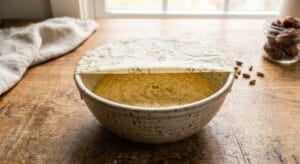
Mix batter and rest the most important step in semolina cake: In a large bowl, combine semolina, caster sugar, and ground cardamom. Add melted butter or ghee and mix thoroughly until every grain of semolina is coated with fat this fat coating is important for the cake’s final texture, lubricating the semolina particles and preventing the finished cake from feeling dry or gritty. Add room-temperature yogurt and mix until completely incorporated. Add beaten eggs and rose water and mix until smooth. The batter at this stage will be thick, slightly grainy, and look nothing like a typical cake batter do not be alarmed. Add baking powder and fold in. Now comes the most critical step: cover the batter with a plate or plastic wrap and allow to rest at room temperature for minimum 20–30 minutes. During this rest, the semolina absorbs the liquid from the yogurt and eggs, fully hydrating and swelling transforming from grainy, loose batter into a thicker, more cohesive, properly developed batter that bakes to a magnificent texture.
Semolina Cake on Desi Bites
Prepare the tin and preheat Pakistani diamond-cut tradition: Preheat oven to 170°C (fan-forced) or 180°C (conventional). Grease a 9-inch round cake tin or a square tin generously with butter or ghee every surface including the sides. If using a square tin, line with parchment for easier removal. The basbousa and Pakistani sooji cake tradition uses a square or rectangular tin that allows the finished cake to be cut into the traditional diamond (lozenge) shapes a cutting pattern that is aesthetically beautiful and culturally familiar from Pakistani mithai and Arab sweet traditions. After greasing, scatter a handful of whole blanched almonds or coarsely crushed pistachios across the base of the tin these will become the top garnish when the cake is inverted, or press them decoratively into the surface of the batter before baking.
Score the batter the traditional diamond cutting technique: Pour the rested batter into the prepared tin and smooth the surface with a wet spatula or the back of a wet spoon the wet surface prevents sticking. Press decorative whole almonds into the surface in a regular pattern if not using the inversion method one almond per future diamond piece, pressed in lightly. Now score the unbaked batter with a sharp knife into the traditional diamond pattern cut parallel lines at approximately 45-degree angles to the tin sides, creating diamond-shaped portions. The scoring serves two purposes: it pre-portions the cake for elegant serving, and it creates channels that the post-baking syrup soak penetrates more deeply and evenly. This scoring tradition connects Pakistani semolina cake directly to the Arab basbousa and Egyptian harissa semolina cake traditions where diamond-cut presentation is culturally essential.
Semolina Cake on Desi Bites
Bake at 170°C watch for the golden top: Bake the scored semolina cake at 170°C for 25–35 minutes checking at 25 minutes. Semolina cake browns more rapidly than all-purpose flour cake due to semolina’s higher natural sugar content and the Maillard-reactive reducing sugars that develop during the resting period. The correct visual indicators of a perfectly baked semolina cake: the surface is deep golden-amber (not pale yellow genuine deep golden color), the edges have pulled slightly from the tin sides, and a skewer inserted in the center comes out completely clean. The surface should feel firm to the touch and spring back when pressed lightly. Do not underbake an underbaked semolina cake will absorb the syrup soak and collapse into a wet, dense, unpleasant mass. A properly baked semolina cake structure absorbs the syrup while retaining its structural integrity.
Make Pakistani cardamom rose syrup while the cake bakes: While the cake bakes, prepare the syrup: combine water and sugar in a small saucepan over medium heat, stirring until sugar dissolves. Add whole cardamom pods and bring to a gentle simmer. Simmer for 5–7 minutes until the syrup thickens slightly (it should coat the back of a spoon lightly not the thick thread consistency of Indian mithai syrup, but noticeably thicker than plain water). Add a generous pinch of saffron allow to steep for 2 minutes, watching the syrup turn a magnificent golden-amber. Remove from heat. Allow to cool for 5 minutes, then add rose water and lemon juice both added off heat to preserve their delicate volatile aromatics. The finished syrup should smell extraordinary: saffron-golden, cardamom-warm, rose-floral, with a subtle citrus brightness from the lemon.
Semolina Cake on Desi Bites
Soak immediately the transformation moment: Remove the baked semolina cake from the oven and immediately while it is still maximally hot and porous ladle the warm syrup evenly over the entire surface. Pour slowly and methodically, beginning at the center and working outward to the edges, ensuring every part of the scored surface receives syrup. The hot cake will absorb the syrup with a satisfying hissing sound this is the capillary absorption of the liquid into the open, hot crumb network. Use all or nearly all of the syrup a properly soaked semolina cake is generously, luxuriously saturated, not merely moistened. Allow the soaked cake to rest in the tin for minimum 30 minutes before serving the resting period allows the syrup to distribute evenly through the crumb and the cake structure to stabilize after the liquid addition.
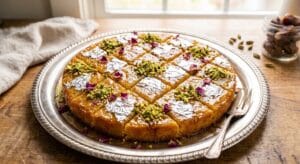
Garnish and serve the Pakistani presentation: After the 30-minute resting period, the semolina cake is ready for its final Pakistani garnish and serving. Scatter a generous amount of crushed pistachios over the syrup-glazed, glistening surface the pistachios’ vivid green against the deep amber cake surface creates a color contrast of extraordinary beauty. Add dried rose petals (gulab patti) for fragrance and visual romance. Apply a touch of silver warq (edible silver leaf) to select diamond pieces for the Mughal aesthetic. Cut along the scored diamond lines the scoring guides visible even through the syrup soak and serve. Semolina cake is excellent at room temperature, genuinely outstanding with a cup of karak Pakistani chai, and surprisingly spectacular warmed slightly with a scoop of vanilla ice cream or a dollop of clotted cream alongside.
Semolina Cake on Desi Bites

5 secrets for perfect Semolina Cake:

Secret 1 Rest the batter minimum 20 minutes non-negotiable:

Resting the semolina batter before baking is the single most important technique in semolina cake making and the most frequently skipped by impatient cooks with consistently disappointing results. Unrested semolina batter bakes into a cake with a gritty, underdeveloped texture the individual semolina particles have not had time to fully absorb the liquid and swell to their proper hydrated state. The rested batter bakes into a cake with a pleasantly substantial but smooth, cohesive crumb the semolina fully hydrated and properly integrated. During the resting period, the semolina absorbs the yogurt’s liquid and acid, the eggs’ water, and the ghee’s fat transforming from separate ingredients into a unified batter of proper development. Do not skip, shorten, or rush this step; the 20–30 minutes of passive resting time costs nothing and determines the cake’s fundamental texture quality.

Secret 2 Soak with hot syrup immediately from the oven timing is everything:

The timing of the syrup application is critical to the quality of the soak and the optimal timing is immediately when the cake comes from the oven while it is maximally hot. Hot cake from the oven has an open, porous crumb structure with active capillary networks that draw in liquid rapidly and completely. As the cake cools, the starch structure firms and the capillaries partially close reducing absorption capacity significantly. A cake soaked immediately from the oven absorbs the syrup completely in 20–30 minutes; the same cake soaked after 30 minutes of cooling may absorb only 50–60% of the same syrup quantity. The practical approach: have the syrup made and warm (not hot warm syrup is absorbed more gently than boiling syrup that can shock the crumb structure) before the cake comes out of the oven, ready to apply within 60 seconds of removal.

Secret 3 Use fine semolina coarse semolina produces gritty cake:

Semolina is available in Pakistani markets in fine, medium, and coarse grinds and the choice of grind fundamentally determines the semolina cake’s texture. Fine semolina (the finest grind available  often labeled “fine sooji” or “barik sooji”) produces a semolina cake with the most refined, smoothest, most cake-like texture the pleasantly distinctive semolina character is present but subtle, providing textural interest without grittiness. Medium semolina produces a noticeable grain that some Pakistani cooks prefer for its more rustic, more intensely sooji character. Coarse semolina (used for pasta and some bread preparations) produces an unacceptably gritty texture in cake it requires much longer hydration than a cake batter resting period provides and should not be used. When in doubt: purchase the finest semolina grind available at your local Pakistani grocery.

Secret 4 Add rose water and kewra to syrup off heat preserve aromatics:

Rose water, kewra water (screwpine essence), and other heat-sensitive Pakistani aromatic waters should always be added to the semolina cake syrup after it has been removed from heat and allowed to cool for 2–3 minutes never while the syrup is actively boiling. The volatile aromatic compounds in these waters phenylethyl alcohol (rose), isocoumarin and 2-acetyl-1-pyrroline (kewra) evaporate rapidly at boiling temperatures, completely defeating the purpose of their addition. Added to warm (not boiling) syrup off heat, these aromatics dissolve fully and remain intact through the syrup’s absorption into the cake, producing a finished semolina cake with a beautifully fragrant, complex aromatic profile. The same principle applies to saffron add it to simmering (not boiling) syrup and allow it to steep off heat for maximum color and flavor extraction without volatile compound loss.

Secret 5 Score before baking, not after deeper syrup penetration:

The traditional diamond scoring of semolina cake batter before baking (rather than cutting the finished cake after baking) serves two critical functions that post-baking cutting cannot replicate. First, structural pre-portioning: the scores baked into the cake create defined, clean cutting lines that guide the knife precisely through the finished cake without crushing the syrup-softened crumb post-baking cutting of a soaked semolina cake often tears and compresses the moist crumb rather than cutting cleanly. Second, and most importantly, syrup channel creation: the baked scores become channels that guide the syrup directly deep into the cake’s interior rather than requiring it to penetrate from the surface alone significantly improving the evenness and completeness of the soak. Score deeply (approximately halfway through the batter depth) for the most effective channels.

Semolina Cake variations:

Classic Pakistani Cardamom Semolina Cake (signature most beloved):

Fine semolina, full-fat yogurt, ghee, eggs, caster sugar, ground cardamom, and rose water baked golden and soaked in a saffron-cardamom-rose water syrup, garnished with whole almonds, crushed pistachios, dried rose petals, and silver warq. This is the definitive Pakistani semolina cake simultaneously connected to the ancient Mughal sooji halwa tradition and the Arab basbousa tradition, completely Pakistani in its aromatic identity, and genuinely one of the most satisfying and most culturally resonant cakes in all of Pakistani baking. Outstanding for Eid celebrations, Ramadan iftar dessert, Friday family gatherings, and as a gift to neighbors and friends during Islamic celebrations. Every Pakistani family that tries this cake adopts it immediately as their own.

Lemon Semolina Cake (Greek revani-inspired):

Add the zest of 2 lemons to the semolina batter and replace the rose water with fresh lemon juice. Soak with a lemon syrup (water, sugar, lemon juice, lemon zest simmered together) rather than the rose water syrup. The lemon completely transforms the semolina cake’s character from warm, spiced, deeply Pakistani to bright, citrus-forward, Mediterranean. The lemon’s acidity cuts through the semolina’s density beautifully, producing a cake that feels lighter and more refreshing than the spiced version while retaining all of semolina’s characteristic moisture and texture advantages. Garnish with thin lemon slices and a dusting of icing sugar for a visually elegant, strikingly simple presentation. Outstanding for summer Pakistani gatherings as a refreshing alternative to heavier desserts.

Coconut Semolina Cake (Pakistani-tropical fusion):

Replace ½ cup of semolina with desiccated coconut and add coconut milk in place of half the yogurt producing a semolina cake with a tropical aromatic complexity and additional chewiness from the coconut that creates an interesting textural interplay with the semolina. The coconut’s natural sweetness and fat contribute to an extraordinarily moist, rich cake that absorbs the cardamom-rose syrup with even greater completeness than plain semolina versions. Toast the desiccated coconut lightly before adding for a nuttier, more complex coconut flavor. Garnish with toasted coconut shavings, crushed pistachios, and dried mango pieces for a tropical-Pakistani garnish combination of both beauty and flavor harmony.

Rose and Pistachio Semolina Cake (Mughal luxury version):

Increase the rose water in both batter and syrup, add a generous amount of finely ground pistachios (½ cup) to the batter alongside the semolina, and tint the batter a subtle pale green with a tiny drop of food color or additional pistachio paste for a visually striking effect. Soak with an extra-fragrant rose water syrup with additional kewra water added alongside. Garnish lavishly with whole pistachios arranged in the traditional Mughal pattern, silver warq, and fresh dried rose petals. This rose and pistachio semolina cake is the most opulent, most Mughal-aesthetic, and most prestigious version of the Pakistani semolina cake appropriate for the most formal celebrations, for gifting to honored guests, and for occasions where the cake must be as visually magnificent as it is delicious.

Tips and tricks:

  1. Rest batter minimum 20–30 minutes non-negotiable. Unrested semolina produces gritty texture; rested semolina produces smooth, cohesive, magnificent crumb.
  2. Soak immediately from the oven while maximally hot warm cake absorbs syrup completely; cooled cake absorbs only partially, producing uneven moistness.
  3. Use fine sooji (barik sooji) coarse semolina produces unacceptable grittiness. Fine grind gives distinctive texture without roughness.
  4. Add rose water and kewra to syrup off heat boiling destroys volatile aromatics. Add after removing from heat and cooling 2–3 minutes.
  5. Score deeply before baking creates syrup channels for even, deep penetration. Score halfway through batter depth, not just surface marks. Date Cookies
  6. Use full-fat yogurt only low-fat yogurt produces a drier, less tender cake. The fat in dahi is essential for the cake’s final texture richness.
  7. Use ghee rather than butter for the most Pakistani character ghee’s nutty depth adds a dimension of flavor that dairy butter cannot provide.

Frequently Asked Questions:

Q1. What is Semolina Cake called in Pakistan?

Semolina cake is called sooji ka cake or suji ka cake in Urdu. Also called basbousa (the Arab name adopted in Pakistani food media), or sooji mithai/sooji halwa ka cake connecting it to the beloved sooji halwa tradition. In Pakistani cafe culture, increasingly called “semolina cake” in English or “sooji cake” in the mixed Urdu-English typical of urban Pakistani food culture.

Q2. Is Semolina Cake the same as basbousa?

Closely related both semolina-based, both syrup-soaked. Pakistani semolina cake differs in aromatic profile: uses cardamom, rose water, kewra, and saffron rather than basbousa’s typical vanilla and coconut. Pakistani versions use ghee rather than vegetable oil, producing a distinctly richer, more Mughal-flavored result. Techniques are essentially identical the difference is entirely in aromatics and garnishes that make Pakistani semolina cake unmistakably South Asian in character.

Q3. Can I make Semolina Cake without eggs?

Yes eggs primarily provide binding and moisture. Substitutes per egg: 3 tbsp yogurt (strengthens lactic acid tenderization); flax egg (1 tbsp ground flaxseed + 3 tbsp water rested 5 min); 3 tbsp condensed milk (adds binding and sweetness). Egg-free semolina cake is slightly denser the generous syrup soak compensates beautifully. The syrup’s moisture is particularly valuable in egg-free versions.

Q4. Why is my Semolina Cake gritty?

Two primary causes: insufficient batter resting (most common semolina not fully hydrated) or using coarse-grind semolina instead of fine. Solutions: always rest batter minimum 20–30 minutes (ideally 1 hour); always use fine-grind barik sooji; ensure yogurt and eggs are room temperature (cold liquid slows semolina hydration significantly). If grittiness persists: briefly blend dry semolina in food processor before using to reduce particle size further.

Q5. How much syrup should I use for Semolina Cake?

A generous application the finished cake should be clearly, visibly moist and glistening, not merely touched with liquid. Standard ratio for 9-inch cake: 1 cup water + ¾ cup sugar (approximately 1¼ cups finished syrup) use all of it. The cake cannot be “over-soaked” if properly baked — a well-baked semolina cake absorbs enormous quantities without becoming soggy because its grain structure holds liquid within its network rather than collapsing.

Q6. How long does Semolina Cake last?

Remarkably well significantly longer than conventional cakes. Room temperature covered: 3 days excellent quality, often improving day two as syrup distributes fully. Refrigerated sealed: up to 1 week. Syrup’s high sugar content is hygroscopic (retains moisture) and acts as natural preservative. Quality genuinely improves with 1–2 days resting bake the day before serving for the best possible result.

Q7. Can I make Semolina Cake without yogurt?

Yes substitutes: full-fat sour cream (same acidity and fat virtually identical results); coconut milk yogurt for dairy-free (subtle coconut note); labneh thinned with small amount of water (richer, more concentrated); full-fat milk + 1 tbsp lemon juice (replicates lactic acid function reasonably well). Always avoid low-fat alternatives fat content is essential for tenderness and richness. Yogurt strongly preferred; substitutes produce acceptable but not identical results.

Q8. What do I serve with Semolina Cake?

Best pairings: karak Pakistani chai (warm spices in cake and chai create natural harmony one of the finest cake-beverage pairings in Pakistani culture); vanilla ice cream (cold neutral creaminess against warm spiced syrup-soaked cake is extraordinary); clotted cream or kaymak (thick Pakistani malai adds dairy richness); fresh fruit particularly mango or pomegranate seeds (tartness cuts through sweetness beautifully); or simply alone at room temperature where the cake’s own qualities need no accompaniment.


You May Also Like:

Rose Cake Complete Guide, Elegant Pakistani Recipe, and 5 Stunning Variations

Leave a Comment

Your email address will not be published. Required fields are marked *

Scroll to Top