Mango Butter Complete Guide, Homemade Recipe, Skin Benefits, and 5 Pakistani Variations

Mango Butter Complete Guide, Homemade Recipe, Skin Benefits, and 5 Pakistani Variations

Complete guide         Pakistani aam fusion        Culinary + skincare                                                   Easy             5.0 / 5

Mango Butter is one of the most extraordinary, most versatile, and most luxuriously rich natural products that the magnificent mango tree Pakistan’s beloved fruit offers beyond its incomparably delicious fresh fruit a pale ivory, gently aromatic, silky-smooth butter extracted from the seeds of mango fruit that functions simultaneously as one of the world’s finest natural moisturizers, an outstanding cooking fat and flavor base, a nourishing hair treatment, a dairy-free baking ingredient, and a genuinely unique Pakistani seasonal preparation that transforms what would otherwise be discarded mango seeds into a product of remarkable quality and value. Mango butter aam ka makhan in Pakistani Urdu is the hidden treasure inside every mango kernel, a preparation that traditional Pakistani and South Asian communities have known about for centuries but that is now experiencing a global renaissance as the natural beauty, plant-based cooking, and zero-waste food movements simultaneously discover its extraordinary properties.
In Pakistan, the connection between mango butter and national food identity is particularly profound Pakistan produces some of the world’s finest mangoes, with legendary varieties like Chaunsa, Sindhri, Anwar Ratol, and Langra celebrated internationally as among the most exceptional fruits on earth. During Pakistan’s glorious mango season from May through August, the country consumes mangoes in staggering quantities and every single one of those mangoes contains a seed that harbors a kernel rich in a remarkable fat. The tradition of extracting and using this mango seed kernel fat for cooking, for hair treatment, for skin care has deep roots in South Asian village and traditional household practice, representing centuries of intuitive understanding of the mango tree’s complete generosity as a resource.
In this complete guide you will find everything needed to understand, make, and genuinely master mango butter its extraordinary history in Pakistani and global traditional knowledge, the remarkable science of mango seed kernel fat composition and its skin and culinary properties, the step-by-step process of extracting homemade mango butter from Pakistani mango seeds, five outstanding variations and applications from culinary to skincare, and all the professional tips that guarantee consistently pure, smooth, wonderfully aromatic results every single time.

Aam Ka

Makhan

Season

May–August

Dual

Culinary + skin

Easy

Skill level


The history of Mango Butter in Pakistani and global traditional knowledge:

The mango tree Mangifera indica has been cultivated across the Indian subcontinent for over 4,000 years, making it one of the oldest and most culturally significant cultivated fruit trees in the history of South Asian civilization. Every part of the mango tree has been used therapeutically and practically across millennia of South Asian traditional knowledge the leaves for diabetes management in Ayurvedic medicine, the bark for diarrhea treatment, the flowers for fever reduction, the fruit flesh for dozens of culinary preparations, and the seed often discarded as waste in modern contexts for its remarkable fat content that South Asian traditional practice has recognized and utilized for as long as mango cultivation has existed.
Mango butter extraction from the seed kernel is documented in ancient Ayurvedic texts the Charaka Samhita and Sushruta Samhita both reference mango kernel preparations for medicinal and cosmetic purposes. Traditional South Asian women have used mango kernel fat as a hair treatment and skin moisturizer for centuries applying it to hair for shine and nourishment during Pakistan’s harsh summer heat, and to skin as a dry-season moisturizer during the cold winter months when the subcontinent’s dry winds cause significant skin dehydration. In traditional Pakistani village households, mango seeds were routinely dried, shelled, and the kernel fat extracted rather than discarded a practice of remarkable resource efficiency that modern zero-waste cooking movements are rediscovering with great enthusiasm.
Globally, mango butter has become a significant ingredient in the international natural beauty and cosmetics industry valued for its exceptional emollient properties, its light non-greasy texture, its gentle mango-adjacent fragrance, and its outstanding compatibility with human skin chemistry. West African mango butter (from the Shea-mango family) and Indian mango butter are now available in cosmetic formulations worldwide. In culinary applications, mango butter is increasingly used in West Africa as a cooking fat and in South Asian fusion cooking as a flavor-forward fat for baking and confectionery. Pakistan, with its extraordinary mango production and deeply established mango culture, is uniquely positioned to develop and celebrate its own mango butter tradition.

The science of Mango Butter fat composition and extraordinary properties:

What is inside a mango seed kernel?

The mango seed has two distinct components: the hard outer shell (endocarp) and the inner kernel (seed proper) that resembles a large, flat, off-white bean. It is this inner kernel that contains mango butter fat. The kernel is approximately 10–15% fat by weight a meaningful fat content that makes extraction worthwhile, particularly given the large number of mango seeds available during Pakistan’s mango season. The fat in mango kernel is a complex mixture of triglycerides predominantly composed of stearic acid (39–57%), oleic acid (38–50%), and palmitic acid (4–6%). This specific fatty acid profile — high in both stearic acid and oleic acid gives mango butter its characteristic properties: a melting point just below body temperature (making it solid at room temperature but liquid on skin contact), exceptional moisturizing properties, and outstanding oxidative stability.

Why Mango Butter melts at skin temperature:

The magic of mango butter on skin the way it immediately transforms from a solid into a silky liquid as it contacts body heat is a direct consequence of its stearic acid content. Stearic acid has a melting point of approximately 69°C as a pure compound, but in the complex mixture of triglycerides that constitutes mango butter, the melting point of the fat blend is approximately 32–38°C just at or slightly below normal human skin temperature of 37°C. This means mango butter is conveniently solid for storage and handling at room temperature, but melts immediately and completely on contact with skin or in the warmth of the hand transforming into a luxuriously smooth oil that absorbs readily without leaving a greasy residue.

Mango Butter as a culinary fat why it works:

Mango butter’s culinary utility comes from its high stearic acid content stearic acid is a neutral-tasting saturated fat that provides stability at cooking temperatures, a smooth mouthfeel in confectionery applications, and a desirable solid texture at room temperature that dairy butter also achieves through its own saturated fat content. Mango butter’s high oleic acid content (same as olive oil) additionally provides antioxidant stability that makes it resistant to rancidity a significant practical advantage over more polyunsaturated cooking fats. In culinary applications, mango butter provides a subtle fruity warmth that enriches everything from traditional Pakistani mithai to modern dairy-free baked goods without overwhelming the dish’s primary flavors.

Benefits of Mango Butter:

Vitamin E

Skin antioxidant

Stearic

Acid — emollient

Oleic

Acid — nourishing

Zero

Dairy — vegan

Mango butter is one of the most nutritionally and cosmetically impressive natural plant butters available providing a combination of compounds that benefits both the skin and body simultaneously. For skin application: mango butter contains vitamin E (tocopherol) a fat-soluble antioxidant that protects skin cells from oxidative damage, accelerates wound healing, and provides meaningful UV damage mitigation. Phytosterols in mango butter (sitosterol, stigmasterol, and campesterol) are structurally similar to human skin’s own lipids they integrate naturally into the skin barrier, supporting its structural integrity and reducing transepidermal water loss. The oleic acid content penetrates deeply into the dermis, delivering moisture and nutrients to the deepest functional skin layers. Stearic acid creates a protective surface layer that traps moisture without clogging pores.
Vitamin E skin protection: Mango butter’s vitamin E content provides meaningful antioxidant protection against UV-induced skin damage particularly important for Pakistani skin exposed to intense subcontinental sun.
Deep moisturization:  Oleic acid penetrates the dermis deeply, delivering lasting moisture to layers that surface moisturizers cannot reachmaking mango butter exceptionally effective for chronic dry skin.
Skin barrier support: Phytosterols structurally similar to human skin lipids integrate into the skin barrier, reducing water loss and strengthening the skin’s natural protective function.
Non-comedogenic:  Despite its richness, mango butter does not clog pores it absorbs cleanly without leaving a greasy film, making it suitable for all skin types including oily and acne-prone Pakistani skin.

Ingredients:

For Homemade Mango Butter (From Pakistani Mango Seeds)

Pakistani Mango Seeds

10–15 large fully ripe

Oven or Sun

50°C oven 2–3 hrs or sun-dry

Heavy Knife / Nutcracker

For cracking seed shell

High-Power Blender

For grinding kernels to butter

For Pakistani Culinary Mango Butter Spread

Mango Butter

½ cup room temperature

Mango Pulp (Chaunsa)


Step-by-step Homemade Mango Butter from Pakistani Mango Seeds:

Collect and clean mango seeds during peak mango season: During Pakistan’s mango season (May–August), collect the seeds from ripe, fully eaten mangoes rather than discarding them. The larger the mango variety, the larger the seed and the higher the kernel fat yield Chaunsa, Sindhri, and Langra seeds are ideal for mango butter making. After extracting the seed from the eaten mango, wash each seed thoroughly under cold running water to remove all attached mango flesh any remaining flesh will cause rapid fermentation and mold during the drying process. The cleaned seed has a fibrous outer husk covering the hard inner shell. Allow cleaned seeds to air dry briefly on a clean towel before proceeding.
Mango Butter on Desi Bites
Remove the fibrous outer husk reveals the hard shell: The fibrous husk covering the mango seed can be peeled away by hand when the seed is still slightly damp and fresh the fibers loosen and can be pulled away to reveal the smooth, tan-brown hard shell beneath. If the husk has dried and hardened, soak the seed in warm water for 10–15 minutes to re-soften the fibers before removing. This husk-removal step reveals the hard, oval, shell-covered kernel inside the tan shell is hard but considerably thinner than the whole husk-covered seed. The shell must be removed in the next step to access the soft kernel within that contains the mango butter fat.
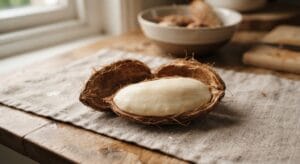
Crack the hard shell access the kernel within: The mango seed’s hard tan shell must be cracked open to extract the pale, off-white to light green soft kernel inside. This is the most physically demanding step of mango butter making. Use a heavy, sturdy knife positioned along the seed’s thinner edge and apply firm pressure the shell cracks along a natural seam running around the seed’s perimeter. Alternatively, use a nutcracker positioned on the seed’s thinner edge. The shell is hard but brittle once the right pressure point is found. Inside is a flat, oval, off-white kernel resembling a large flattened bean this is the mango kernel (also called mango kernel or aam ki giri) that contains the precious mango butter fat. Collect all kernels carefully.
Mango Butter on Desi Bites
Dry the kernels removes moisture for efficient fat extraction: Place the extracted kernels on a clean baking sheet in a single layer. Dry in an oven at the lowest possible setting (50–60°C) for 2–3 hours until the kernels are completely dry they should snap cleanly when bent rather than bending flexibly, indicating complete moisture removal. Alternatively, sun-dry in Pakistan’s abundant summer sun for 2–3 days on a clean surface, turning once or twice daily. Complete drying is essential any remaining moisture in the kernel causes steam during the blending-to-extraction process and can lead to rancidity in the finished butter. The dried kernels shrink slightly, darken minimally, and become harder. Store dried kernels in a sealed container for up to 6 months before extraction if mango season has ended.
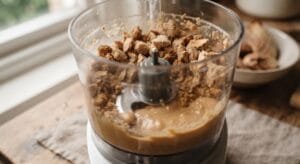
Grind dried kernels the fat release process: Break the dried kernels into smaller pieces for easier blending. Add to a high-powered blender or heavy-duty food processor. Blend at high speed for 3–5 minutes the friction and heat generated by the blending process releases the fat from the kernel’s cellular structure. Initially, the ground kernel will appear as a dry, crumbly powder. After 2–3 minutes of continuous blending, the fat begins to release and the mixture progressively transforms from dry powder into a paste, then into a thick, smooth, glossy mass exactly the same process that transforms peanuts into peanut butter. Stop when the mixture is smooth and glossy with a creamy consistency. The color at this stage is a warm, pale tan-yellow this is raw, unrefined mango butter.
Mango Butter on Desi Bites
Strain for refined butter optional but recommended: For purer, more refined mango butter: gently heat the blended mango kernel paste in a double boiler (a bowl set over simmering water) until it becomes completely liquid approximately 10–15 minutes at gentle heat. Strain the liquid fat through a fine mesh strainer lined with muslin cloth, pressing firmly to extract all liquid fat while leaving behind any remaining fine particle matter. The strained liquid is pure, refined mango butter. Allow to cool at room temperature it will solidify from liquid amber-gold to a solid pale ivory-cream as it cools and the fat crystallizes. Unrefined mango butter (not strained) is equally effective for skincare and most cooking applications straining primarily improves appearance and smoothness.
Store correctly seal and label with mango season date: Transfer the solidified mango butter to a clean, dry glass jar. Store at room temperature in a cool place away from direct sunlight mango butter is stable at room temperature for 1–2 years due to its high stearic acid content (saturated fats are highly resistant to oxidative rancidity). Refrigeration is not necessary but extends shelf life further. Label the jar with the mango variety and date of preparation different Pakistani mango varieties produce mango butters with subtly different fat compositions and aromatic profiles. Chaunsa mango butter has a particularly delicate, sweet fragrance; Sindhri produces a slightly more robust, earthier butter. Both are outstanding.
Mango Butter on Desi Bites

5 secrets for perfect Mango Butter:

Secret 1 Use fully ripe, fully eaten mango seeds only:

The fat content and quality of mango butter varies significantly with the ripeness of the mango from which the seed is extracted. Fully ripe mangoes the ones eaten at peak sweetness and aroma have seeds with fully developed kernels containing maximum fat content and the finest aromatic profile. Under-ripe or prematurely harvested mangoes have seeds with less developed kernels and lower fat content. In Pakistan, the finest mango butter comes from seeds of the most prized varieties at their peak ripeness a Chaunsa seed from a mango eaten at perfect ripeness in July produces measurably finer butter than one from an under-ripe early-season fruit. Collect seeds throughout the season and use the later-season, fully ripe variety seeds for the finest results.

Secret 2 Dry kernels completely before grinding:

Incomplete drying of mango kernels before grinding is the most common cause of mango butter failure producing a paste that fails to release its fat cleanly, remains sticky and wet rather than becoming smooth and buttery, and develops rancidity within days due to residual moisture enabling microbial activity. The kernels must be completely, unambiguously dry snap-brittle when bent, producing a clean crack rather than bending. This is most reliably achieved in a low oven (50°C) for 2–3 hours rather than sun-drying, which depends on weather conditions and is harder to standardize. A moisture meter if available should read below 5% moisture the equivalent of commercial dry standards. Invest the drying time and the mango butter extraction will proceed smoothly and produce a shelf-stable product.

Secret 3 Use a double boiler for refinement never direct heat:

When refining mango butter through gentle melting and straining, the use of a double boiler rather than direct heat on the pan is absolutely essential. Direct heat on a pan concentrates temperature at the bottom surface creating localized temperatures far above the boiling point of water that can scorch the mango butter’s more delicate flavor compounds, destroy heat-sensitive vitamin E and phytosterols, and produce a finished butter with an unpleasant cooked or burnt note. A double boiler maintains the butter at a gentle 60–80°C throughout sufficient to melt completely for straining but gentle enough to preserve all delicate aromatic and nutritional compounds intact. Never rush mango butter refinement with high direct heat.

Secret 4 Blend mango pulp concentrate separately for culinary butter:

For making culinary mango butter the spread variation that combines mango kernel fat with mango fruit flavor the mango pulp must be concentrated before incorporation rather than added fresh. Fresh mango pulp contains approximately 82% water adding it directly to mango butter produces a butter that separates into greasy fat and watery fruit liquid almost immediately. Concentrate mango pulp by cooking it in a small pan over medium heat, stirring constantly, until it reduces to approximately one-third of its original volume and becomes thick, jammy, and deeply intensified in flavor. This concentrated pulp incorporates cleanly into mango butter, producing a stable, smooth, intensely mango-flavored spread of extraordinary deliciousness.

Secret 5 Store away from light and heat mango butter does not need refrigeration:

Mango butter’s high stearic acid content makes it one of the most oxidatively stable natural plant butters available it does not require refrigeration and maintains excellent quality at room temperature for 1–2 years when stored correctly. The two primary enemies of mango butter quality in storage are light (which triggers photo-oxidation of the vitamin E and aromatic compounds) and heat above 40°C (which softens or melts the butter and can cause quality degradation over time). Store in a dark glass jar in a cool cupboard or pantry away from the stove or any heat-generating appliance. Dark glass prevents light exposure; a cool, stable temperature environment prevents thermal degradation. In Pakistan’s hot summer climate, a cool interior cupboard or the bottom shelf of a refrigerator during peak summer heat is ideal.

Mango Butter variations and applications:

Pakistani Culinary Mango Butter Spread (aam ka makhan signature):

Mango butter blended with concentrated Chaunsa mango pulp, local honey or jaggery, a pinch of cardamom, and a tiny pinch of salt producing a golden, intensely aromatic, deeply mango-flavored spread of extraordinary luxury. This Pakistani culinary mango butter is one of the most original and most genuinely outstanding spreads in Pakistani fusion food spread on warm paratha or naan for a breakfast of exceptional pleasure, used as a finishing butter for grilled chicken or fish, stirred into oatmeal for a Pakistani-flavored breakfast bowl, or spread on roti for children who love the combination of familiar flatbread and beloved mango flavor. Nothing in Pakistani food culture more completely captures the essence of mango season than this spread.

Pakistani Mango Butter Mithai (kaju-aam fusion):

Use mango butter as the fat base for traditional Pakistani mithai preparations replacing ghee or dairy cream in barfi, halwa, and ladoo formulations. Mango butter’s high stearic acid content means it sets firmly at room temperature just as ghee-based mithai does producing beautifully firm, slice-able mithai with an additional subtle mango undertone that adds a completely new aromatic dimension to familiar preparations. Mango butter barfi made with milk powder, sugar, cardamom, and mango butter produces a confection of extraordinary delicacy. The mango butter’s natural affinity with the mango’s own flavor compounds creates a synergy that makes mango-butter mithai taste more intensely mango than preparations using neutral ghee.

Mango Butter Baking Fat (dairy-free Pakistani baking):

Use solidified mango butter as a 1:1 replacement for dairy butter in Pakistani baking applications cookies, cakes, bread enrichment, and pastry. Mango butter’s fat composition is similar enough to dairy butter to function equivalently in most baking applications it creams with sugar, melts appropriately during baking, and provides comparable richness and tenderness to baked goods. The subtle mango aromatic note in the finished baked good is a genuinely interesting flavor addition mango butter cookies have a barely perceptible but distinctly pleasant tropical warmth that dairy butter cannot provide. For Pakistani chai biscuits and nankhatai, mango butter produces an outstanding dairy-free version with a uniquely Pakistani aromatic identity.

Mango Butter Skin Moisturizer (Pakistani natural beauty):

Take a small amount of pure mango butter (approximately the size of a chickpea) and warm between palms until completely liquid. Apply to face, hands, or body with gentle circular motions. The butter absorbs completely within 2–3 minutes, leaving skin deeply moisturized without greasiness. For a lighter texture suitable for Pakistani oily-skin types: melt mango butter with an equal amount of aloe vera gel and whip together until a lighter cream forms. For a deeply nourishing winter body butter: blend mango butter with coconut oil, a few drops of rose water, and vitamin E oil for a luxurious Pakistani-fragrant body moisturizer that is completely natural, completely free of synthetic chemicals, and made entirely from ingredients available throughout Pakistan.

Mango Butter Hair Mask (Pakistani desi beauty secret):

Melt 2 tablespoons mango butter with 1 tablespoon coconut oil. Add a few drops of kalonji (black seed) oil a Pakistani hair treatment tradition with thousands of years of documented use. Apply to hair from roots to tips, massaging into the scalp for 5 minutes. Cover with a warm towel and leave for 30–60 minutes. Wash out with a gentle shampoo. Mango butter’s oleic acid deeply penetrates the hair shaft, providing lasting moisture and shine. The stearic acid coats the hair cuticle, reducing frizz and improving smoothness. Pakistani women in traditional households have used mango kernel fat for this purpose for generations this modern formulation simply adds the proven benefits of coconut and kalonji oils to a centuries-old tradition.

Tips and tricks:

  1. Use fully ripe Pakistani mango seeds only peak ripeness means maximum fat content and finest aromatic profile.
  2. Dry kernels completely until snap-brittle incomplete drying causes extraction failure and rapid rancidity.
  3. Use double boiler for refinement direct heat scorches vitamin E and aromatic compounds irreversibly.
  4. Concentrate mango pulp before adding to culinary butter fresh pulp water content causes immediate separation.
  5. Store in dark glass jar away from light and heat stable at room temperature 1–2 years without refrigeration.
  6. Collect seeds all season and dry in batches dried kernels keep 6 months, allowing year-round mango butter production.
  7. A tiny pinch of salt in culinary mango butter amplifies the mango flavor dramatically, as with all sweet preparations.

Frequently Asked Questions:

Q1. What is Mango Butter called in Pakistan?

Mango butter is called aam ka makhan or aam ki giri ka tel in Urdu. The mango seed kernel is aam ki giri. Older texts may refer to it as aam ka roghan (mango’s fat/oil). In cosmetic contexts, increasingly called “mango butter” in English as Pakistani beauty culture adopts international ingredient terminology. Traditional South Asian communities have known and used this preparation for centuries as a hair and skin treatment.

Q2. Is Mango Butter edible?

Yes pure mango butter is completely edible and safe for culinary use. Used as a cooking and food fat in South Asian and West African food cultures for centuries. Used in mithai, cooking oil blends, and as dairy butter substitute. The refined extracted butter is completely safe. Note: the whole raw kernel contains mangiferin and tannins that may cause mild digestive discomfort in sensitive individuals if consumed in large quantities, but the refined butter extraction has no such concern.

Q3. What does Mango Butter smell like?

Pure mango butter has a subtle, gentle, pleasantly warm aroma not the intense tropical fruity mango fruit smell expected, but a mild, slightly nutty, faintly tropical scent that is unmistakably mango-adjacent without being overwhelming. Chaunsa mango butter: particularly delicate, sweet fragrance. Sindhri: slightly earthier, more robust scent. Refined mango butter has a milder, more neutral scent than unrefined. Subtle enough to blend harmoniously with other ingredients without overpowering them.

Q4. Can I use Mango Butter instead of shea butter or cocoa butter?

Yes excellent substitute for both. Vs shea butter: lighter, less waxy texture, less intense aroma preferable for facial application and oily skin types. Vs cocoa butter: comparable fatty acid composition (stearic + oleic dominant), similar melting point, but with subtle mango note rather than cocoa bitterness. Substitutes in chocolate-making and confectionery at 1:1 at significantly lower cost. For skincare: moisturizing and skin barrier effects are comparable to shea butter.

Q5. How long does homemade Mango Butter last?

Outstanding shelf life: 1–2 years at room temperature. High stearic acid content and natural vitamin E provide exceptional oxidative stability no refrigeration necessary. Storage: cool (below 30°C), dark (away from sunlight), dry (no moisture). Signs of spoilage: rancid or musty smell, significant color change, unusual texture. Refrigerated: 2–3 years. During Pakistani summer heat above 35°C, bottom shelf of refrigerator is ideal to maintain solid consistency.

Q6. Which Pakistani mango variety makes the best Mango Butter?

All varieties produce viable butter. Chaunsa: most delicately fragrant large fat-rich seeds, exceptional subtle floral-mango aroma. Sindhri: slightly more robust, higher yield due to large seed size. Anwar Ratol: very aromatic reflecting variety’s intensely perfumed fruit. Langra: good quality, slightly more neutral-flavored. For culinary use where mango flavor is desired: Chaunsa and Anwar Ratol finest. For skincare where minimal scent is preferred: Sindhri and Langra slightly more neutral. Corn Cakes

Q7. Can Mango Butter be used on the face?

Yes particularly well-suited for facial application. Non-comedogenic despite richness does not clog pores, suitable for combination and mildly oily skin. Dry and normal: chickpea-sized amount after washing, absorbs fully in 2–3 minutes. Oily skin: blend with aloe vera gel for lighter formulation. Vitamin E beneficial for Pakistani skin exposed to intense sun. Phytosterols may help reduce hyperpigmentation over time. Avoid if known mango allergy (rare but documented).

Q8. How many mango seeds does it take to make Mango Butter?

Approximately 10–15 large Pakistani mango seeds (Chaunsa or Sindhri size) yield approximately 50–80g finished mango butter enough for 2–3 months daily skincare or several culinary batches. Yield improves with fully ripe seeds from large-seeded varieties and complete drying before extraction. During mango season, collecting seeds from household consumption means the butter is essentially cost-free a remarkable value from what would otherwise be discarded kitchen waste.


You May Also Like:

Tomato Confit Complete Guide, Slow-Roasted Recipe, Pakistani Fusion Uses, and 5 Variations

Leave a Comment

Your email address will not be published. Required fields are marked *

Scroll to Top